


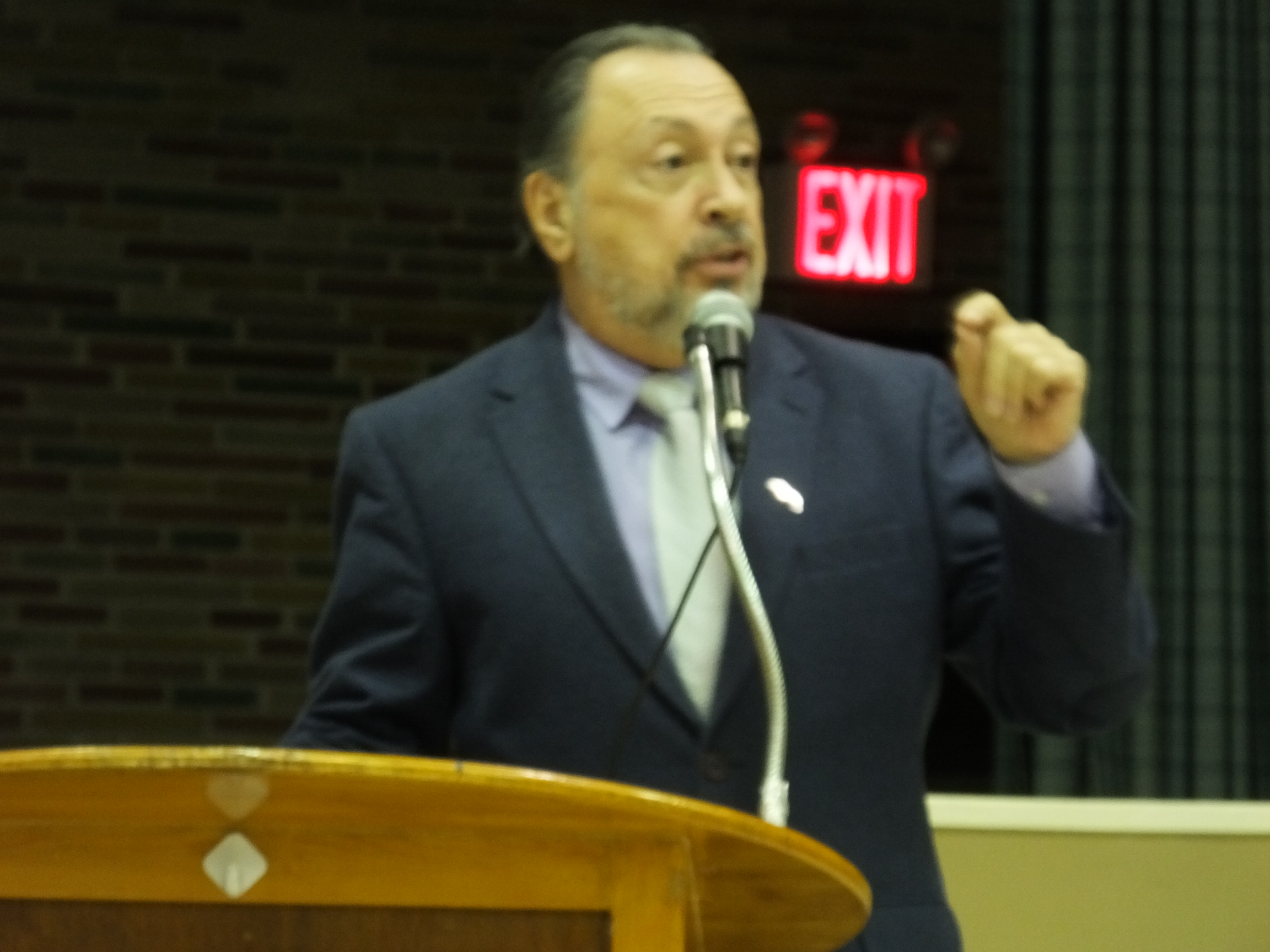
On Monday, November 30, 2015 five speakers presented a "Night of Educational Information" for the community at Levittown Hall. The first guest speaker was Lori Koerner, a parent and an HCT member who teaches third grade at Fork Lane Elementary School. Mrs. Koerner began by reviewing the origins of the Common Core curriculum and the "reformers" who are responsible for it. One of the guiding principles of the Common Core is the premise of "rigor." As Mrs. Koerner pointed out however, according to the dictionary "rigor" is defined as "strictness, harshness, and inflexibility," yet as Diane Ravitch believes, "Some of our most brilliant and intelligent students do not shine on standardized tests because they do not have standardized minds." Some of the unintended consequences for teachers and students as a result of the Common Core are that we have a narrowed fragmented curriculum and children who leave school with no knowledge of the arts, sciences, history, or geography because the major emphasis is to prepare students to take the ELA and math Common Core state assessments. Mrs. Koerner believes that what we need is to bring back project-based learning, portfolios and creative activities. She agrees with Dr. Rita Pierson who believes that the most important function of a teacher is to build the self-esteem of the students. Linking student test results to teachers' APPR (Annual Professional Performance Review) is an inaccurate measure of a teacher's effectiveness. "Teachers want to be evaluated. We are proud of what we do, but we need to be evaluated in a fair way. It's time to take back public education!"
The second speaker was Mr. David Gamberg, Superintendent of Greenport/Southold Schools. He began with the question, "What's worth fighting for?" and then went on to agree with Horace Mann who stated, "The Public School is the greatest discovery made by man." We've had high standards in education long before the Common Core came around, the perfect example being the National Honor Society." Mr. Gamberg believes that authentic engagement should be the key to education and that an appreciation for the arts is worth fighting for. "Children need to explore and dream. The public educational system should be allowed to create a community of learners by fostering a culture of inquiry, and not be forced to focus solely on increasing high-stakes standardized testing scores. Even Einstein believed that imagination is more important than knowledge." Gamberg would like to see a return to the time when children were joyful as they learned.
The third guest speaker was Dr. Steven Cohen, Superintendent of the Shoreham-Wading River Schools. Dr. Cohen thought it ironic that the public education "reformers" who fought for the implementation of the Common Core do not have a background in education and send their own children to private schools. In those private schools, their children are getting a Renaissance education because the teachers in those schools have the flexibility to determine what is developmentally appropriate and are not subjected to the confines of the Common Core. Education in the private school is project-based. Dr. Cohen pointed out that in 2009 Bill Gates foresaw the $600 billion market in Common Core books, educational supplies, and testing materials. Dr. Cohen found it remarkable that politicians didn't require the materials to be tested before they were mandated and implemented into the public school system.
The fourth guest speaker was Dr. Michael Hynes, Superintendent of the Patchogue-Medford Schools. As a father of five, Dr. Hynes sees a strong link between school and emotion. Memories of a favorite song or movie can bring a smile to a person's face. Many people from an older generation smile at the thought of school memories -- a favorite teacher, friendships formed, moments of a "lightbulb" going off in a student's mind when a concept is mastered, performing in a school play ... Unfortunately today students are caught in a crossfire of what's going on in Albany and in Washington, D.C. Their future memories about school will be of over-testing, the restriction of their creativity, and the turning of a disconnected youth to isolated technology as a means of escape. Dr. Hynes believes that there is a significant difference between training and education. Private schools are allowed to provide a well-rounded education for their students because they are not under the constraints of the Common Core, whereas public schools are being forced to "train" their students to excel at taking standardized tests. There is a "culture of fear" being permeated throughout public schools. The majority of students are "failing" the developmentally inappropriate standardized tests year after year beginning in the third grade. He wishes that the "reformers" were informed instead of just opinionated. A heart-wrenching photo of Lori Koerner's son Sean crying as he was trying to complete his homework at the dinner table, but was frustrated and unable to comprehend the assignment, resonated with the audience who night after night experience the same scenario in their own homes. Dr. Hynes implored the other parents, teachers, board of education members, and administrators in the audience to keep the love of learning alive in their own children and students. "Don't let our students not care. Administrators, teachers, and parents must work together to effect change. What you allow is what will continue!" He dismissed the "reformers'" emphasis on over-testing. Believing we can improve our schools with more tests is like believing you can make yourself grow taller by measuring yourself more often. The United States public school system has often been unfavorably compared with that of Finland's. Dr. Hynes ended with a quotation from an interview with a teacher from Finland who stated that "We pay teachers like doctors. Our students enjoy over an hour of recess every day. We have no mandatory testing -- the opposite of what America does."
The final speaker of the evening was Dr. David Ferrin, Psychologist, CPSE Chair, Director of All About Kids and retired HCT member. He spoke about stress and a child's brain. One concerning consequence of stress is that it leads to decreased memory. Dr. Ferrin believes that the emphasis of high-stakes testing has lead to the death of the "Renaissance child" explaining that students are now learning to study only the narrow scope of information that will be tested and to ignore or devalue all other information. Currently at the kindergarten level there is push to replace "play" with academics, yet Dr. Ferrin cited research that proves that play is a child's work. It lays the foundation for children's social interactions as they grow. "Kindergarten should be about the socialization of a human. Children should be learning the essentials of communication, sharing, and taking turns." He has seen all too often the emotional stress of students in early elementary grades manifest itself in crying, tantrums, and wanting to frequently leave the classroom to go to the nurse's office. As a result of the emphasis placed on the outcome of the high-stakes testing, older students at the bottom fifth of their grade are 25 percent more likely to drop out of high school, which is now creating a culture of cheating and avoidance.
In addition to staying informed of what is happening in public education and advocating for positive change, Dr. Ferrin gave advice to parents in the audience about what they could do or say to their children to help them preserve their self-esteem in school during these trying times:
· One test doesn't make or break you.
· I trust you in your ability to do your best.
· I know that you studied hard, and that's what I value the most.
Dr. Ferrin feels it's important to let the children know that your love for them isn't jeopardized by their test performance. Parents know their children better than anyone else, and it is in their hands to make the decision as to whether or not their children should participate in the high-stakes state mandated testing. The most important thing to impart to your children is that they need to learn and enjoy school!

For further information please attend the next "Educational Crossroads" forums which will be held at:
Sayville Middle School
January 4, 2016
7 P.M.
Patchogue-Medford
(Patchogue Library)
January 5, 2016
Comsewogue
JFK Middle School
January 13, 2016